On Wednesday January 17th a friend dragged me to a “super cool event about television in Miami Beach”. It was the second day of the National Association of Television Program Executives (NATPE), I have to double check the name because I get confused thinking it is NAPTE instead.
So from what I understood, NATPE is an event where content producers gather to present and sell their precious content to big television channels, networks, or to whoever is interested in acquiring it.
There is an exhibition floor filled with lounges and booths of different production companies from all over the world, I saw booths from China, France, Australia, India, Spain, and a couple that caught my eye. One was “iKabron Productions” yeah, I couldn’t get over that name and kept laughing for a few seconds and, the other one was RCTV International. I know about RCTV because it was a channel in Venezuela that the monster of Hugo Chavez ordered to shut down because the channel did not align to his rules. You can read more about it here.
Let’s go back to NATPE (I keep checking if I got the name right as I’m typing). The event also offers talks or chats with television executives and powerful people in the industry, who share their knowledge and opinions about the business. They are all men and the are all white.
The first chat we got into was with Andy Kaplan from Sony Pictures Television and Armando Núñez from CBS. What I got from their remarks is that television isn’t fading away, it is adapting to modern world. I remember Kaplan saying that his 13-year-old daughter watches a lot of TV, he also said that there are more talks in his house about Stranger Things (a Netflix serie) than ever before. And this takes me to the feeling I got out of the whole chat, it seems to me that all these television executives and producers are afraid about Netflix and other online streaming services, but they kept mentioning Netflix. So, it’s cool that Mr. Kaplan shares about his daughter’s obsession with Stranger Things, but on what platform does she watch that serie? Through Netflix, on a computer, tablet, smartphone, or a PS4 connected to a TV (that’s how we watch it at home). Hence, where does that place television on a household? Do they consider Netflix television? Because I don’t.

Another point that was mentioned on the talk, this time by Núñez was that countries like India and Australia are demanding content like the one we consume here in the U.S. I only hope that the content delivered in those countries goes along the lines of the demographic and their culture. Imagine a Hindu girl watching a show or a cartoon about a blonde, white, blue-eye girl, how could she identify with the character? Wouldn’t it create or deepen stereotypes of beauty that have caused so much pain and insecurities in tons of girls all over the world? Just saying. Núñez also mentioned how social media allows you to know right on the spot if a show is getting kudos or boos. He gave an example, or well, many examples with Star Trek, how one of his kids would read to him people’s reactions on Twitter to one of the episodes, “they love it” or “the hate it”.
At the end of the chat, I was less convinced about the survival of television in the upcoming years.
We got late to the Marc Jacobson talk, he works for Facebook and the tittle of his talk was: “How Can a Listening Culture Help Businesses Drive Results and Recruit Talent?”. What I remember about his message is that today, big companies have to be willing to listen when their people tell them that something sucks without repercussions. But what stayed with me was a message on the images of the screen. Imagine a white canvas with several orange squares, each square had a written phrase or a question in white letters. The question that stood out to me was: “What would you do if you were not afraid” – Gosh, a hundred thoughts came to my head.
Right after that talk, we stayed in the room for “A Conversation with Jane Fonda”. My friend wanted to see that interview so bad, I had no idea who she was, I had to google her, yeah I am not great with movies. Turns out this lady was full of energy, funny, a very experienced actress, and she is 80 years old. I was like WHAT? So, I googled her again and yes, she was born on 1937. I don’t want to throw shadow at her but… How many plastic surgeries has she gone through? She doesn’t look 80 at all, and the most insane thing is that she’s still working and acting. When the interviewer asked her how much longer she wants to keep acting, she said: “until I can’t talk anymore” – I admire and applaud that.
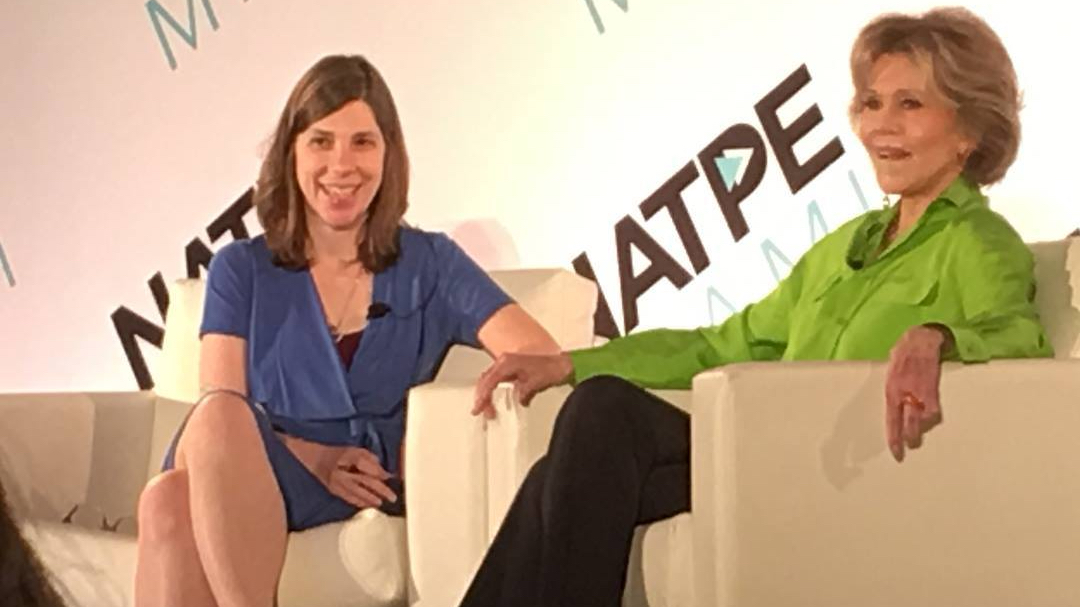
What I couldn’t stand of this interview was the interviewer herself, again, my intention is not to be rude, but take this in consideration: she wore flats, she didn’t do her hair, it looked kind of messy, she didn’t have any make up on and she was interviewing freaking Jane Fonda, are you kidding me? The interviewer was Cynthia Littleton, she is a reporter for Variety which I respect and I think it is a great job. So please girl put some effort on your image for this type of interviews and events, interviewing Jane Fonda is sort of a big deal. Also improve your delivery. She spoke so slow and soft that Jane Fonda herself told her to speak up, “can they even hear you?”, the actress asked.
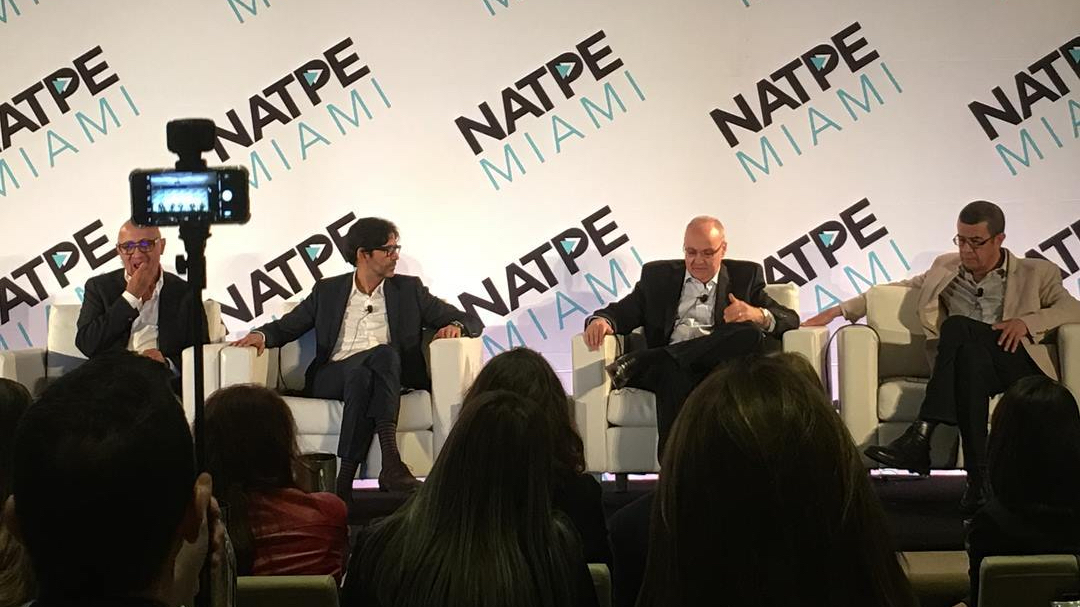
The last chat we went to was in Spanish, it was called ‘Buyer Evolution/La evolución del Buyer’, Coproducing the Future. There were four Hispanic speakers, Alberto Ciurana from Azteca TV, Dago García from Caracol Television, Eric Jurgersen from America TV Peru and Marcos Santana from NCB Universal Telemundo International. It was a very interesting chat, and the message was similar to the first talk that we went to: television is not dying, it will continue to exits. Mr. Jurgersen explained four reasons why television won’t die, one of the reasons has to be with advertising and commercials, the best way to advertise is through a TV screen and another reason had to do with the birth or the emergence of a brand, it is always better through television.
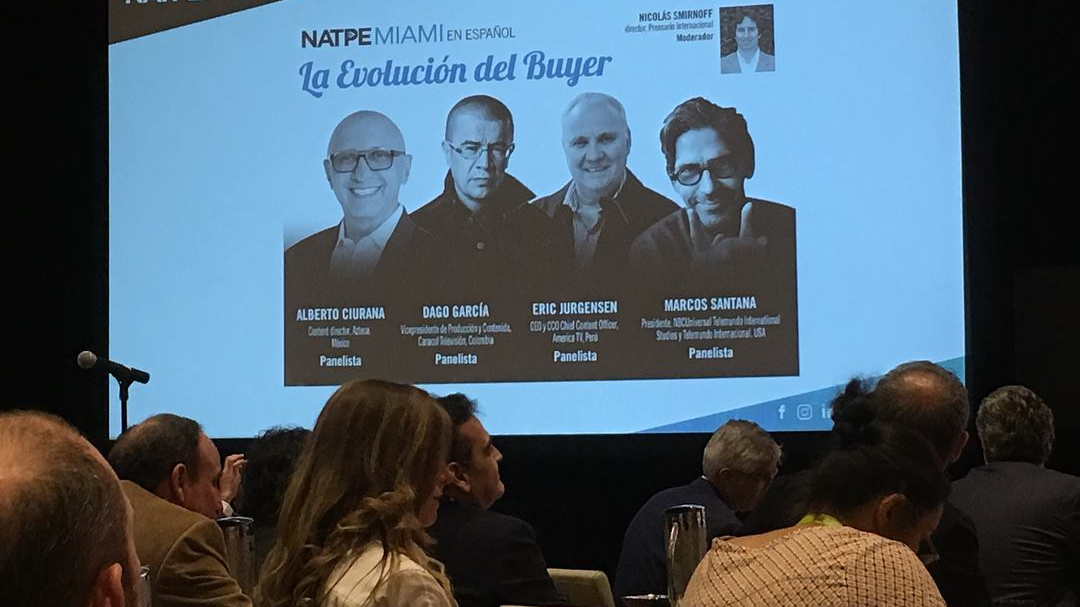
Mr. Santana as soon as he opened his mouth we realized that he is Venezuelan, my friend and I looked at each other like “say whaaat?”, anyway, he gave the audience a cool fact: in 2017, there were 465 fiction series produced. In addition, Santana admitted that today there is no loyalty from the audience to one network or one channel like in the past, now people follow a show, no matter the network. This comment was related to a discussion about the content in local television. I got the idea that these men feel that the content in local TV is great, but why so many viewers are turning to online services to watch their favorite shows? I think local TV in Spanish, in Miami is not great at all. I would only rescue the newscast; however, some of them are disappointing. Television in Español is full of shows from somewhere else or shows where the content is poor, shallow, gossipy and derogatory toward women.
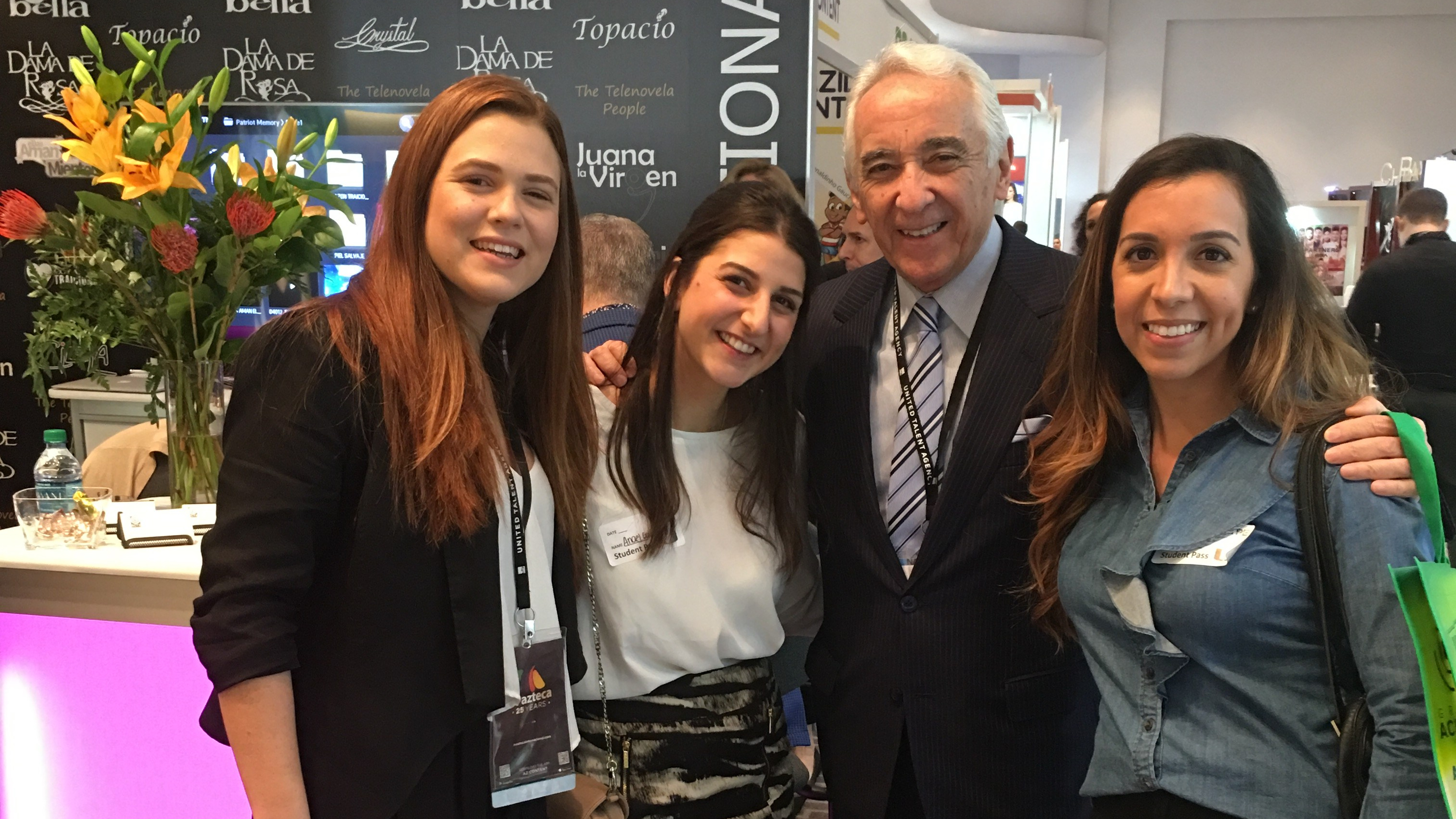
At the end of the day, we walked through the exhibition floor one more time, but this time we had the honor of seeing and meeting Eladio Lárez, a well known businessman and TV personality in Venezuela. He hosted “Who wants to be a millionaire?” (the Venezuelan version) back in the day when RCTV was still on air. I remember calling to the show to participate, the machine would asked you several questions to see if you could make it to the show. I was a teenager and didn’t know crap ha, and then my mom yelled at me when she saw the phone’s bill because there was a charge for calling. I still remember the number and I could sing it to you 09 00 172 88 88. Eladio introduced us to José Simón Escalona, RCTV’s production vice president, Escalona told me about their most recent projects for television, a type of soap opera for a young audience, all produced and shot in Venezuela. I watched the trailers, and it looked decent. I felt hopeful and relieved that finally somebody in that event was showing me something modern that a younger audience could relate to.
I definitively enjoyed my day at NATPE 2018, I feel that I learned something new, and I was challenged to improve as a bilingual professional in the media.
 Hello, I am Vanessa Brito
Leave a comment